Medical and Non-Newtonian Flows
Selected Research Projects
Image-based blood flow simulations of intracranial aneurysms
Responsible person: Dr.-Ing. Philipp Berg
See also: https://www.forschungscampus-stimulate.de
Intracranial aneurysms are pathological dilations of the cerebral arteries. They can occur even in young individuals and may lead to death or irreversible disability if rupture occurs. Image-based numerical simulation can be used to assess the risk of rupture. This risk-free approach enables a detailed characterization of individual hemodynamics. A wide range of metrics can be derived and used for risk evaluation. Furthermore, the approach can be extended to coupled fluid–structure interaction simulations. In addition to hemodynamics, these models also represent the vessel wall and its mechanical properties. The focus lies on a realistic description of the complex interactions, taking into account mechanical wall properties and pathological changes. The overall goal is to gain a deeper understanding of the underlying mechanisms in order to support the development of reliable rupture risk models.
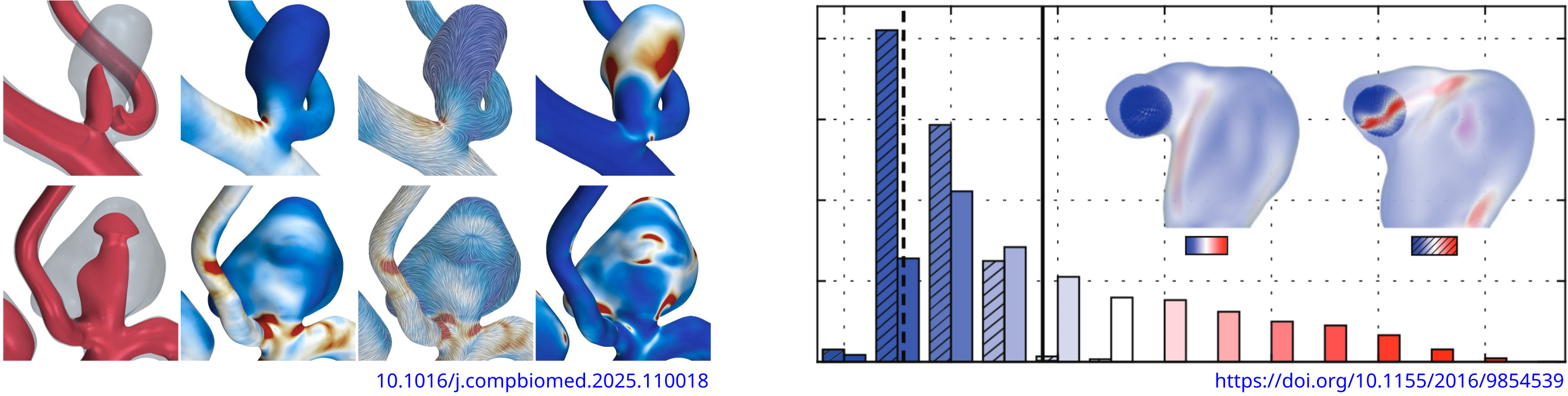
Figure: Left: Visualization of hemodynamic parameters in patient-specific aneurysms (from left to right): velocity iso-surface, wall shear stress, line integral convolution, and oscillatory shear index. Right: Differences in vessel wall stress obtained from fluid–structure interaction simulations using constant versus patient-specific wall thickness.
Simulation and optimization of implants for endovascular treatment of intracranial aneurysms
Responsible person: Dr.-Ing. Samuel Voß
In addition to analyzing aneurysm hemodynamics, endovascular treatments can be virtually modeled and optimized on a patient-specific basis. Intraluminal devices (e.g., flow-diverter stents), intrasaccular approaches (e.g., Woven EndoBridge, Contour Neurovascular System), and embolization techniques (platinum coils) can be simulated without risk to the patient. These therapy options are clinically used to restore physiological vessel conditions by reducing inflow into the aneurysm, increasing blood residence time, and promoting thrombosis. Image-based blood flow simulations enable the evaluation of implant performance, comparison of different treatment options, and targeted optimization of devices in collaboration with medical device manufacturers.
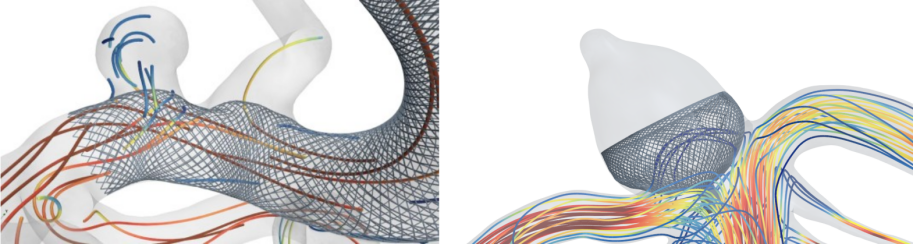
Figure: Left: A virtually deployed flow-diverter stent covering the aneurysm neck and a side branch. Right: An intrasaccular implant reduces inflow into a bifurcation aneurysm. In both cases, velocity-coded streamlines illustrate the modified blood flow within the aneurysm.
Image-based blood flow and vessel wall simulations of venous diseases
Responsible person: M.Sc. Janneck Stahl
See also: https://www.forschungscampus-stimulate.de
Cerebral venous abnormalities, particularly dural venous sinus stenosis, can impair venous outflow and is increasingly recognized as a contributor to pulsatile tinnitus. Due to their anatomical proximity to inner ear structures, abnormal post-stenotic flow may generate perceivable sound. Computational fluid dynamics enables detailed characterization of downstream flow features such as jets, vortices, and instabilities, while fluid-structure interaction allows assessment of vessel wall vibrations. The resulting flow and wall-motion signals can be analyzed in the time-frequency domain and visualized using spectrograms to identify relevant frequency components. Together, these approaches provide a promising non-invasive framework for patient-specific assessment and treatment planning.
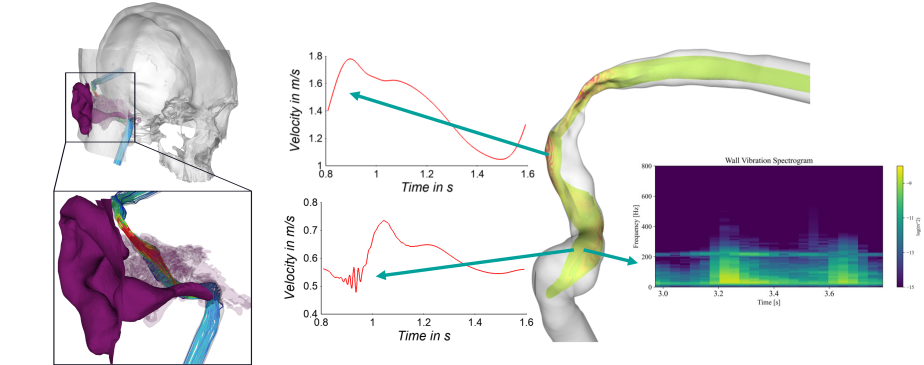
Figure: Left: Schematic illustration of complex blood flow in a stenosis of the right transverse sinus. Here, the vessel is in direct contact with the temporal bone, which transmits sound to the inner ear structures (shown in purple), potentially leading to pulsatile tinnitus. Right: High-resolution computational fluid dynamics simulations enable the detection of high-frequency pulsations in blood flow and the visualization of vessel wall motion signals using spectrograms.
Simulations of airflow in the upper airways
Responsible person: Dr.-Ing. Samuel Voß
Comprehensive flow simulations enable the analysis of transitional flow phenomena within the human larynx during breathing. Direct numerical simulations (DNS), large-eddy simulations (LES), and lattice Boltzmann methods (LBM) are employed for this purpose. Using patient-specific models based on clinical CT data allows for a highly realistic representation of airflow. The subsequent analysis of velocity fields focuses on comparing healthy and diseased airways. In addition, relationships between flow characteristics, respiration, and voice quality are investigated.
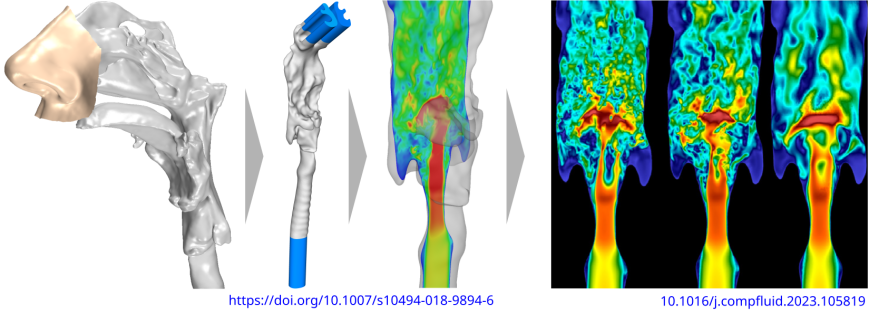
Figure: Left: Segmentation of the upper airways from the nasal cavity to the upper trachea followed by flow simulation. Right: Level of flow resolution achieved using three different simulation approaches.
Experimental Flow Measurements in Order to Validate Blood Flow Predictions
As part of the Research Campus STIMULATE with Grant Number 13GW0095A
Responsible person: Dipl.-Ing. Christoph Roloff
See also: https://www.forschungscampus-stimulate.de
Computational Fluid Dynamics (CFD) is a promising tool in better understanding hemodynamic processes and in finding or optimizing solutions to related problems. However, due to the model-like simplifications that were inevitably made, the validation of such calculations remains essential. Therefore, high-resolution in-vitro flow measurements with advanced optical methods (Particle Image Velocimetry (PIV), Particle Tracking Velocimetry (PTV)) are continuously being worked on within the project to further boost confidence in the simulations. In particular, the investigation of cerebral aneurysms in conjunction with flow affecting medical implants (flow diverter, stent, etc.) stands at the center of this research.
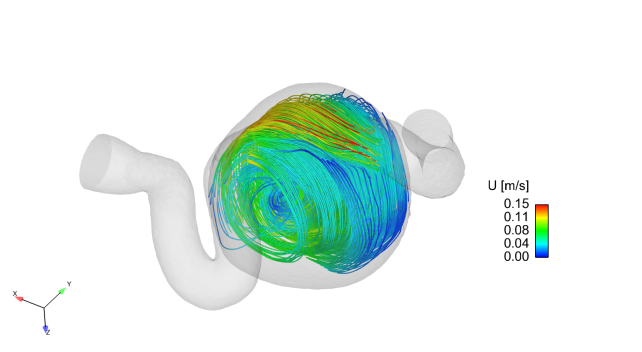
Figure: Streamlines within a patient-specific geometry of an aneurysm measured by stereo PIV on a silicone model.
Numerical Modeling of Blood Damage in Fluid Flows
Responsible person: M.Sc. Sebastian Engel
Flow simulations are an importing building block in the development on low-impact medical products. The development of blood-wetted devices such as blood pumps is especially challenging. Blood can be exposed to impacts more severe than natural ones in such artificial environments, which can result in damages to the blood. Damages can result on multiple levels, especially in cellular components: red and white blood cells (erythrocytes and leukocytes) and blood platelets (thrombocytes).
It is necessary to model these damages in order to numerically improve blood flow in artificial devices, for which there are numerous approaches. In ongoing research, modeling methods are being analyzed, compared to each other, and implemented in simulation tools. An emphasis here was placed on the modeling of hemolysis (mechanical damage of red blood cells).
This work provides a basis for the systematic numerical optimizations of blood-wetted devices, e.g., blood pumps. The same methods can, however, also be expanded to other applications such as oxygenators or natural diseases such as stenosis.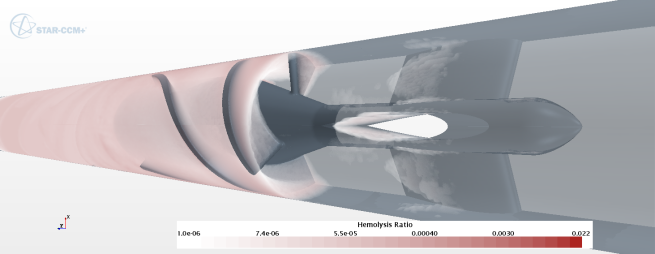
Figure: Spatial distribution of the hemolysis ratio (concentration of hemoglobin in the plasma) in an axial blood pumps. Represented in a volume-rendered distribution. Side view of the impeller and the guide wheel.
Influence of Polymers and Fibers on Pressure Drop in Turbulent Channel Flow
Responsible person: Dr.-Ing. Amir Eshghinejadfard
How the addition of small amounts of additives to fluids effects pressure loss is of great industrial interest. Therefore, this project is experimentally investigating which change in pressure drop can be achieved in a quasi-two-dimensional channel flow with the addition of various materials. The investigations cover a broad area of Reynolds numbers in the channel and material concentrations of two different polymers and five different fiber types. For example, the use of xanthan gum reduced the pressure drop by 22%, an effect that could not be achieved continuously. Using rod-shaped carbon fibers a pressure drop reduction of 3% was observed. Overall, a dependency on the aspect ratio (shape) of the fibers, however, no dependency on Reynolds number is displayed.
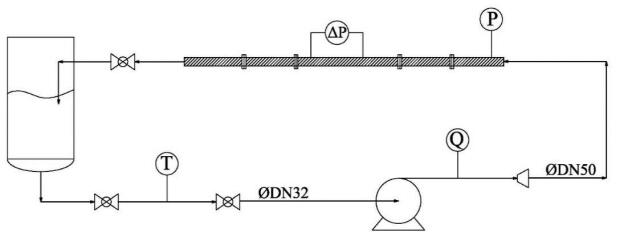
Figure: Schematic layout of the test facility for the investigation of the influence of additives on pressure drop in the flow channel.
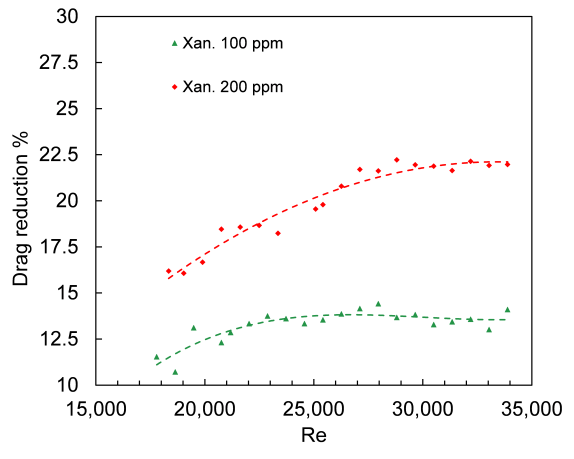
Figure: Pressure drop reduction as a function of the Reynolds number for xanthan gum.